
We Cling to the Mascot
These days, it feels like people know Aloka, a former stray dog now turned into The Peace Dog, more than the Buddhist monks he is walking with.
That is not a complaint against the dog. I love the dog too. Aloka is adorable, symbolic, and strangely comforting. But what is troubling is what this popularity reveals about us. Many people can recognize Aloka, share his photos, and talk about him with emotion, yet most do not bother to ask why the monks are walking for peace in the first place.
Aloka becomes the headline. The monks become the background.
And in that simple shift, we see a larger human habit.
We cling to the mascot.
The easy symbol
Why does Aloka attract more attention than the monks?.
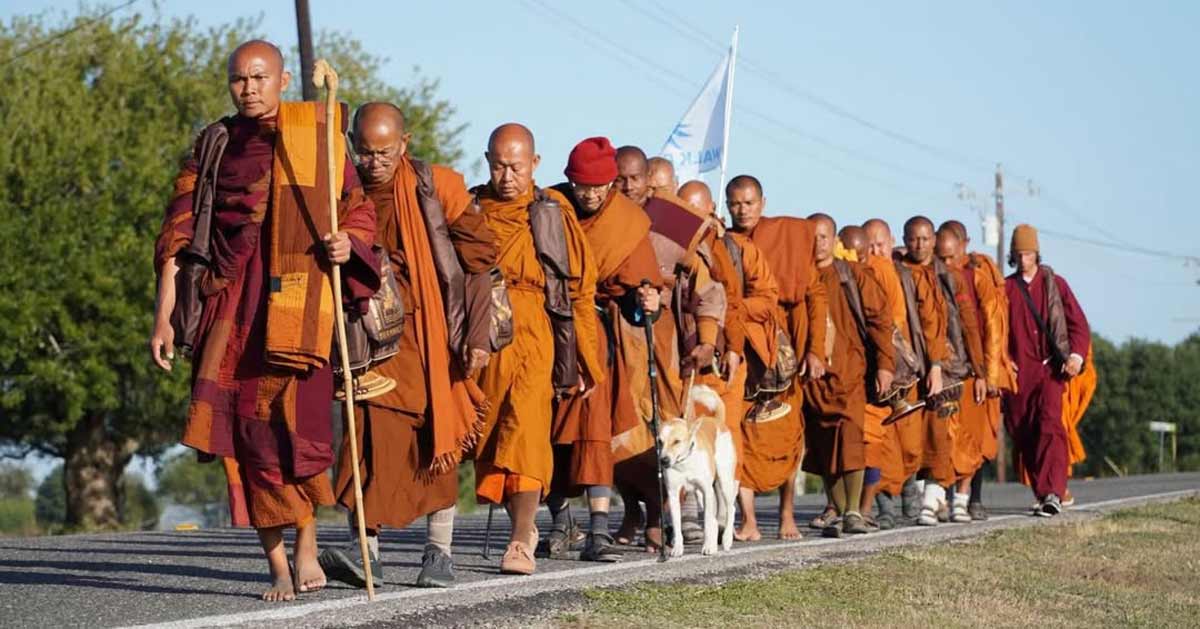
Because Aloka is a low-resistance sign. You do not need context. You do not need theory. You do not need political literacy or religious vocabulary. A stray dog walking with monks looks self-evidently meaningful. The meaning lands instantly, like a soft touch on the heart.
In a world exhausted by arguments, that kind of symbol is irresistible.
A monk, however, carries weight. Monks come with tradition, discipline, doctrine, and interpretation. A peace walk can provoke questions: Whose peace? In what context? Against what violence? With what political implications? Many people do not want those questions. They want what is simpler.
So the public can support Aloka without feeling pressured to take a political stance.
No debate.
No discomfort.
Only affection.
That is why he spreads so quickly.
That is why he is loved so easily.
And yet, this “ease” is not innocent. It is revealing.
We cling to the mascot.
The credible witness
There is something deeper happening too. Aloka becomes not merely a mascot but a credible witness.
Human beings are complicated. Institutions are mistrusted. Motives can be questioned. Agendas can be suspected. Even moral movements are sometimes doubted.
But a stray dog carries none of that burden. A dog cannot manipulate. A dog cannot pretend. A dog cannot perform goodness for attention.
So a quiet logic forms in the mind of the public.
- If the dog chose them, they must be kind.
- If the dog trusts them, they must be safe.
- If the dog follows them, they must be good.
The dog becomes a living certificate of authenticity.
And then comes the most irresistible part: Aloka’s story fits a powerful folklore motif.
- The abandoned one joins a sacred journey.
- The orphan becomes the sign of goodness.
- The outsider becomes the heart of the story.
This is ancient narrative structure. Myth and folktale know how to do this. Even modern people who claim not to believe in myths still respond to them emotionally. We may not call it folklore. But we feel it as inevitability. We feel it as meaning.
So Aloka becomes a story people can carry.
The twist: the mascot as doorway
And yet, there is a twist that complicates our judgment.
It may be true that Aloka gets more attention than the monks. It may also be true that without Aloka, many of us would never have heard of these monks at all. In that sense, the mascot is not only a distraction. The mascot is also a doorway. Aloka becomes the bridge between a quiet spiritual act and a noisy digital world. People may come for the dog, but they still arrive at the monks. Even if curiosity is shallow at first, it is still curiosity. Even if the attention begins with a symbol, it can still lead to the substance.
So perhaps the question is not whether Aloka should be loved. He should. The deeper question is whether we will stop at the mascot, or whether we will follow the mascot to what he points toward.
But stopping at the mascot is the uncomfortable truth. Yes, Aloka is not the problem. Aloka is the mirror.
We are moved by peace as long as it comes wrapped in an easy symbol. We share signs, but avoid the discipline behind the signs. We admire meaning, but hesitate to carry meaning in our own lives.
The monks are walking peace with their bodies.
That is endurance.
That is sacrifice.
That is a slow practice against cynicism and cruelty.
But most of us do not want the walk.
We want the dog.
And the same pattern exists everywhere, not only here. This is not new. It is simply more visible now.
Many so-called Christians hang the cross in their cars. The cross swings from the mirror like a protective charm. It looks holy. It signals identity. It feels like faith.
But the real cross is not a decoration. The real cross is a way of living: costly love, humility, forgiveness, truthfulness, sacrifice. That cross does not hang neatly in the car. That cross becomes heavy on the soul.
So we choose the symbol.
We display it.
We circulate it.
And then we move on.
We cling to the mascot, not to what it stands for.
Modern life has made symbolic emotion even easier.
It is as easy as sending ❤️💋😘 emojis on WhatsApp to someone, without actually having the feelings. We can perform love with our thumbs while keeping our hearts untouched.
We can say “I miss you” without missing.
We can say “I care” without caring.
We can say “peace” without changing anything about ourselves.
Our age has perfected signs without substance.
That is why the mascot is safe. The mascot demands nothing.
To love Aloka, we only need emotion.
But peace requires courage.
Truth requires honesty.
Justice requires consistency.
Love requires sacrifice.
In other words, peace is not a soft feeling. Peace is a long practice.
Let us love Aloka, yes. He deserves love. But perhaps we should also listen to what his popularity exposes about us. If a stray dog can become more famous than the people walking for peace, then maybe we should ask ourselves a difficult question.
Do we love peace, or do we just love the image of peace?
Because the image is easy.
So yes, let us love Aloka. He deserves love. And perhaps he is even doing sacred work in his own accidental way, by making the monks visible to a world that might otherwise scroll past them. But still, the danger remains. We might meet the monks through the dog, and yet never hear the message the monks carry. We might admire peace in a cute form, and still refuse to practice peace in our own lives. a long walk.
We are becoming a generation that can “react,” but cannot “live.”
We can post love, but not embody love.
We can praise peace, but not practice peace.
We cling to the mascot, but not to what it stands for.
Melkey Chisim