
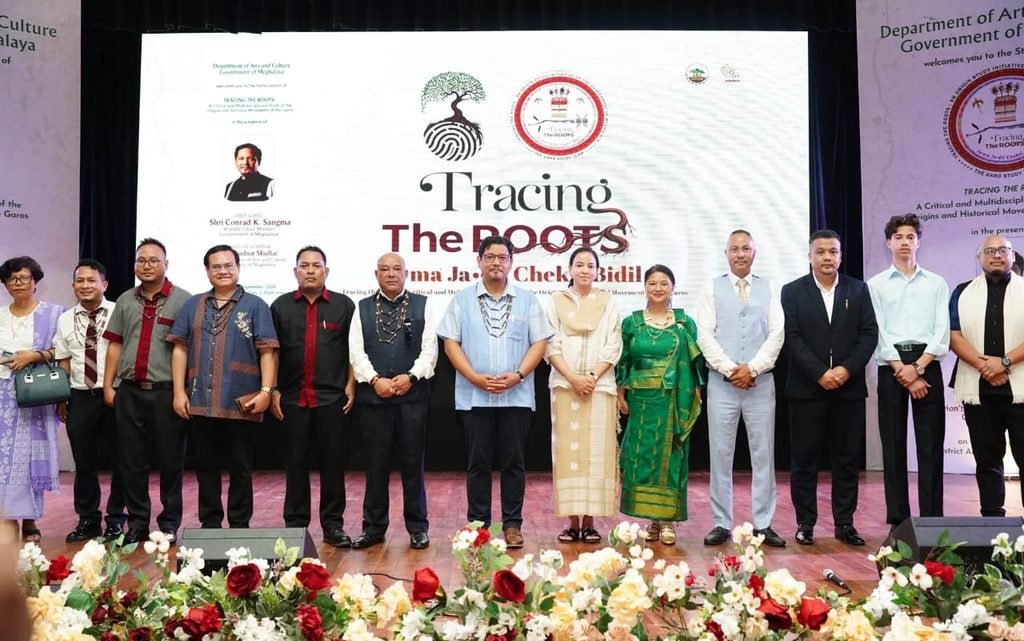
Tracing the Roots: A Critical and Multidisciplinary Study of the Origins and Historical Movements of the Garos is a major multidisciplinary research initiative of the Government of Meghalaya to undertake a systematic and evidence-based study of the history, origins, movements, language, culture and heritage of the Garo people.
The project was formally launched by the Hon’ble Chief Minister of Meghalaya, Conrad K. Sangma, on 1 September 2026 at the District Auditorium, Tura.
The project’s initial research phase will span 24 months, bringing together researchers from several disciplines and regions. It is designed as a large research network, with more than 80 Research Associates and 35+ Cluster Coordinators working across different research areas and Garo-inhabited regions. The 24-month period will lead to the submission of the first consolidated findings, while the research itself is intended to continue, with the knowledge, databases and resources created through the project providing a foundation for further study in the years ahead.
A related initiative for the Khasi-Jaintia community, under the banner REVISITING THE ROOTS and titled Ki Dienjat: Re-examining Khasi-Jaintia Socio-cultural Linkages with Southeast Asia, was launched earlier on 18 August 2026, reflecting the wider commitment to systematic research into the history and roots of the indigenous communities of Meghalaya.
Why is this study necessary?
One of the best-known traditions among the Garos is the narrative that their ancestors migrated from Tibet before settling in their present homeland. Over the years, this tradition has also found its way into books, research articles, dissertations, and other academic writings. While some scholars and members of the community accept this tradition, others question it. At present, there is no empirical evidence either to conclusively accept or conclusively reject it.
Tracing the Roots, therefore, seeks to examine the question through history, archival research, ethnography, linguistics, archaeology, genetics and physical anthropology. Rather than beginning with an accepted conclusion, the study will compare different forms of evidence and examine where they support, qualify or challenge existing accounts. The purpose of the study is to investigate the evidence systematically and allow the findings to determine the conclusions..
Multidisciplinary Research Programme
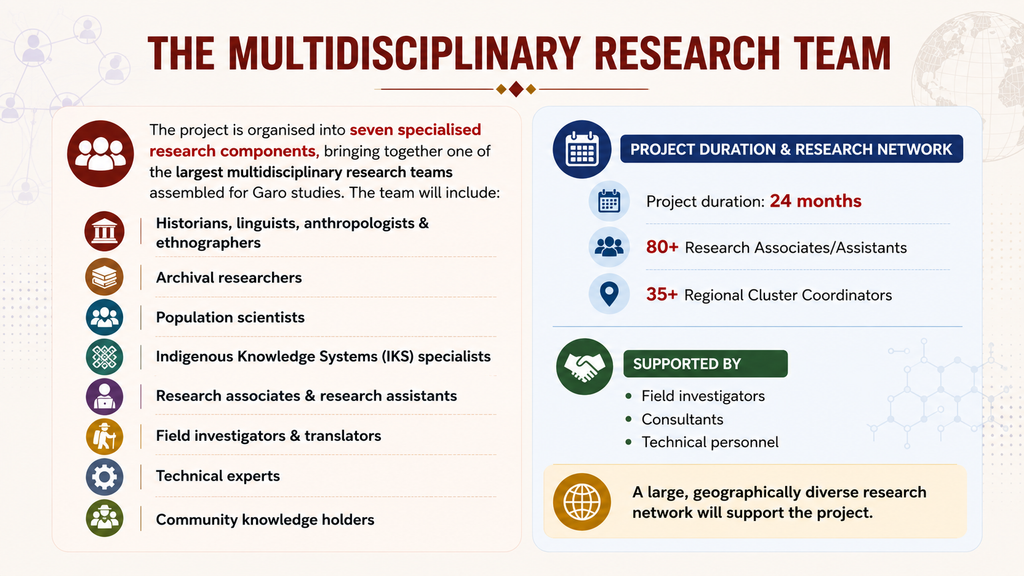
The project is planned as a 24-month research programme involving a large network of researchers, field investigators, scholars and community knowledge holders.
More than 80 Research Associates will contribute to different areas of research, while more than 35 Cluster Coordinators will support structured field documentation across Garo-inhabited regions.
The cluster-based approach is particularly important for the ethnographic component. Instead of relying on a small number of locations, the project will document traditions and cultural information across a wide geographical area. The approved framework provides for 35–45 field clusters, with 35+ Cluster Coordinators serving as structured documentation leads.
This scale allows the project to study both the common elements shared across Garo communities and the regional differences that have developed over time.
7 Concurrent Research Components
The research is organised into seven interconnected components.
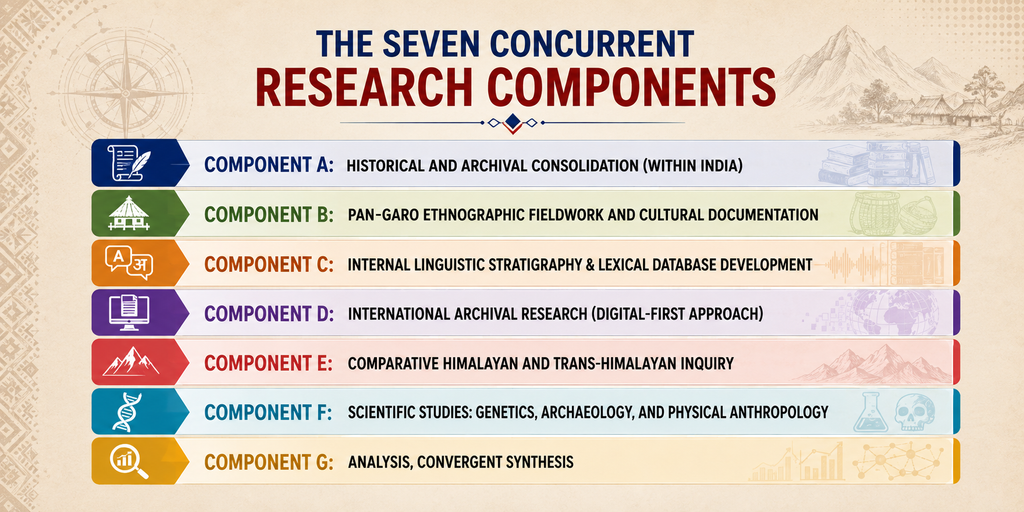
Component A: Historical and Archival Consolidation (in India)
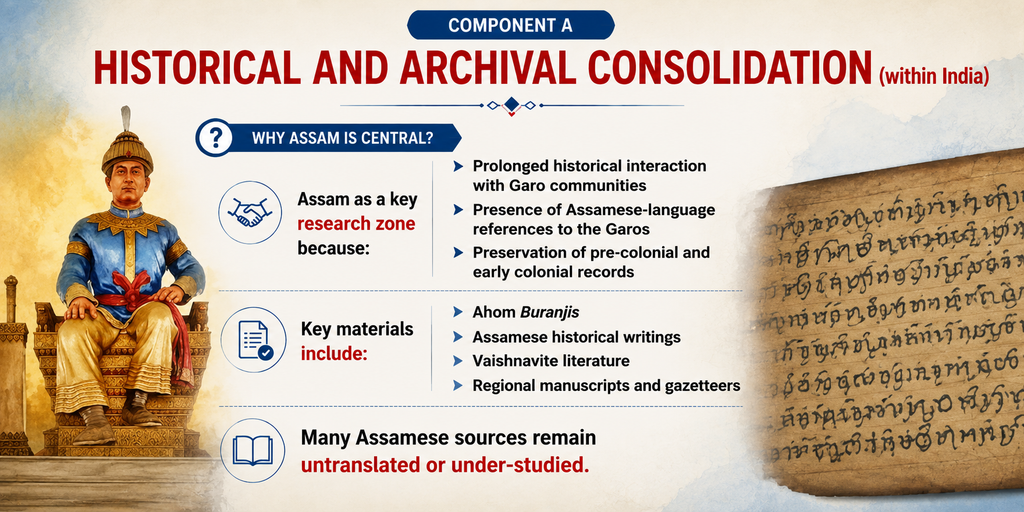
Component A will bring together historical evidence relating to the Garo people from the repositories across India, with particular attention to Assam, which has a long and important historical relationship with Garo communities.
The component will examine historical documents, administrative records, gazetteers, manuscripts, missionary materials and other documentary sources. It will also examine historical terminology, place names, community names and descriptions of Garo society.
An important feature of this work is its planned collaboration with Garo scholars based in Assam, the Garo Sahitya Sabha, and Assamese scholars and language specialists. This collaboration is necessary because many relevant historical materials are preserved in Assamese or in regional archives, and because proper interpretation often requires knowledge of local terminology, historical geography and the context in which records were produced.
The project will therefore not treat archival research as simply a matter of collecting old documents. It will seek to locate, verify, translate, contextualise and compare historical evidence.
The Component A framework specifically provides for Assamese scholarly mediation and translation specialists as well as Garo scholars serving as an interface with Assam’s archival and scholarly resources.
Component B: Pan-Garo Ethnographic Fieldwork
Component B will take a Pan-Garo approach, covering Garo-inhabited areas in Meghalaya, Assam, West Bengal, Arunachal Pradesh, Nagaland, Tripura and Bangladesh. The purpose is not only to document the traditions and cultural practices of individual communities, but also to understand the connections that link Garo communities across present political and geographical boundaries.
The fieldwork will document oral traditions, settlement histories, customs, rituals, traditional knowledge and material culture. In selected clusters, researchers will also study clan histories and genealogical traditions, as well as language maintenance, language use and language vitality, particularly where the Garo language is experiencing sustained contact with other languages.
An important broader objective of this component will be to make efforts towards bringing Garo communities from different Garo-inhabited areas into closer cultural contact and strengthening their sense of shared heritage. By documenting both the common elements and regional variations of Garo life, the component will help create a broader picture of the Garo people as a community whose history and cultural connections extend beyond present administrative boundaries.
Component C: Linguistic Stratigraphy and Lexical Database Development
Component C will focus on the systematic documentation and study of the Garo language, with the principal output being an IPA-based digital lexical database.
A major part of the work will be the domain-wise compilation of Garo lexical items. Vocabulary will be organised into meaningful areas of life such as kinship, agriculture, environment, flora and fauna, food, material culture, body, social institutions, rituals, beliefs and other culturally significant domains. This will make the database useful not only as a linguistic resource but also as a record of the knowledge and cultural world embedded in the Garo language.
The database will also record regional and dialectal variation, along with lexical change and borrowing. By bringing this information together in a systematic digital format and representing the vocabulary using the International Phonetic Alphabet (IPA), the project will create a durable resource for researchers, educators, language planners and future generations. It will also contribute towards the standardisation of Garo orthography. The resulting database will be a lasting resource for linguistic research, education, language documentation and language maintenance.
Component D: International Archival Research
Some of the most valuable records concerning Garo language and society may be located outside India, particularly in missionary, university and specialised archival collections. Component D will therefore undertake international archival research using a digital-first approach.
The project will first identify relevant materials through online catalogues and digitised collections. Where important materials cannot be accessed digitally, researchers may undertake targeted institutional visits. This approach allows the project to search a much wider range of collections while using physical travel only where it is necessary. The research will include the identification, acquisition, digitisation, translation, annotation and interpretation of relevant historical materials. The ultimate goal is to bring scattered documentary evidence into a more accessible and organised research resource.
Component E: Comparative Trans-Himalayan Inquiry
Component E is the project’s major historical-comparative linguistic investigation. It will examine the wider debate concerning the geographical origins and early dispersal of the language family to which Garo belongs. The terminology itself remains an area of scholarly discussion, including the use of terms such as Sino-Tibetan, Tibeto-Burman and Trans-Himalayan.
The study will then focus specifically on the phylogenetic position of Garo and the Boro-Garo group. Researchers will examine historical classification, phonology, grammar, vocabulary, sound correspondences, cognates and reconstructed forms. Competing interpretations of Garo’s linguistic relationships will be evaluated using established comparative methods.
Importantly, this component is designed as a decision point. The project does not assume in advance that Garo’s linguistic history requires investigation in Tibet.
If the existing linguistic evidence is sufficient to explain Garo’s position, further Tibetan research may not be necessary. If the linguistic evidence identifies a significant unresolved northern or Himalayan connection, the project can then undertake targeted investigation in the relevant Himalayan or Tibetan region. Thus, the direction of any future Tibet-related research will be determined by the linguistic evidence.
Component F: Scientific Studies: Genetics, Archaeology and Physical Anthropology
Component F will introduce a scientific evidence stream through genetics, archaeology and physical anthropology, with the scientific work being undertaken in collaboration with the Department of Anthropology, North-Eastern Hill University (NEHU). The component will follow appropriate ethical standards, informed consent procedures, scientific protocols and safeguards for the handling of genetic information.
A particularly important outcome will be the creation of a Garo reference genetic database. This will provide a scientific baseline for future studies of Garo population history and allow the Garo genetic profile to be compared, where scientifically appropriate, with reference populations and datasets from other regions. The genetic study will examine haplogroup patterns, classical genetic markers and other relevant population-genetic markers, together with appropriate statistical and comparative analysis. Laboratory processing, quality control and secure data management will form part of the study.
The importance of this work extends beyond the question of whether a Himalayan or Tibetan investigation is eventually undertaken. Even if Component E does not trigger a Tibet-based investigation, Component F will remain important because it will create a Garo-specific genetic reference resource that can support future research on population history, ancestry and genetic relationships. If Component E does identify a linguistic basis for further investigation, the genetic reference database can additionally provide a foundation for a comparative genetic test involving relevant populations identified through the linguistic and historical research.
Component G: Convergent Analysis, Synthesis and Dissemination
Component G will bring together the findings of all the other components and examine them as parts of one larger historical picture. Its purpose is not simply to place seven separate research reports side by side, but to determine what emerges when historical records, oral traditions, ethnographic findings, linguistic evidence, archival materials, archaeology, genetics and physical anthropology are considered together.
The component will identify areas where different forms of evidence converge, complement one another or contradict one another. Where evidence points in different directions, those differences will be carefully examined rather than forced into a single conclusion. This will help distinguish well-supported findings from interpretations that remain uncertain or require further research.
A structured evidence-convergence framework will be developed to record the findings of the different components and assess their relative strength. This will provide the basis for a comprehensive interpretation of Garo history, origins and historical movements, while clearly identifying questions that may remain unresolved.
The final findings will then be made accessible through scholarly publications, reports, digital resources and public dissemination, so that the knowledge generated by Tracing the Roots is not confined to the project team. Important research materials and outputs will also be organised and preserved as a lasting resource for future researchers, educational institutions and the Garo community.
In this way, Component G will serve as the synthesis and knowledge-sharing stage of the entire project, ensuring that the final understanding of Garo history emerges from the convergence of evidence rather than from any single narrative or discipline.
The Seven-Volume Publication
The culmination of Tracing the Roots will be the preparation of a seven-volume publication, bringing together the research generated through the seven components of the project.
The publication will provide a comprehensive and permanent record of the project, preserving its historical, ethnographic, linguistic, archival, scientific and analytical findings in an organised form. Rather than presenting a single predetermined account of Garo origins, the publication will document the evidence, interpretations, areas of convergence and remaining questions that emerge from the research.
In this way, the seven-volume publication will become one of the project’s most important lasting contributions: a consolidated body of knowledge on the Garo people, created through multidisciplinary research and made available to future generations.
A Continuing Research Initiative
The 24-month period will mark the first major phase of Tracing the Roots and the submission of its initial consolidated findings, not the end of research. The evidence gathered and resources created during this period will provide a foundation for continued research and further investigation. The seven-volume publication will record the major findings of this initial phase, while the research resources created through the project will remain available for scholars, institutions and the Garo community to build upon in the years to come.
👍🏻👍🏻👍🏻👍🏻👍🏻👍🏻👍🏻👍🏻 Angni hypothesis koba agandamna sikenga… golponan somoi gri